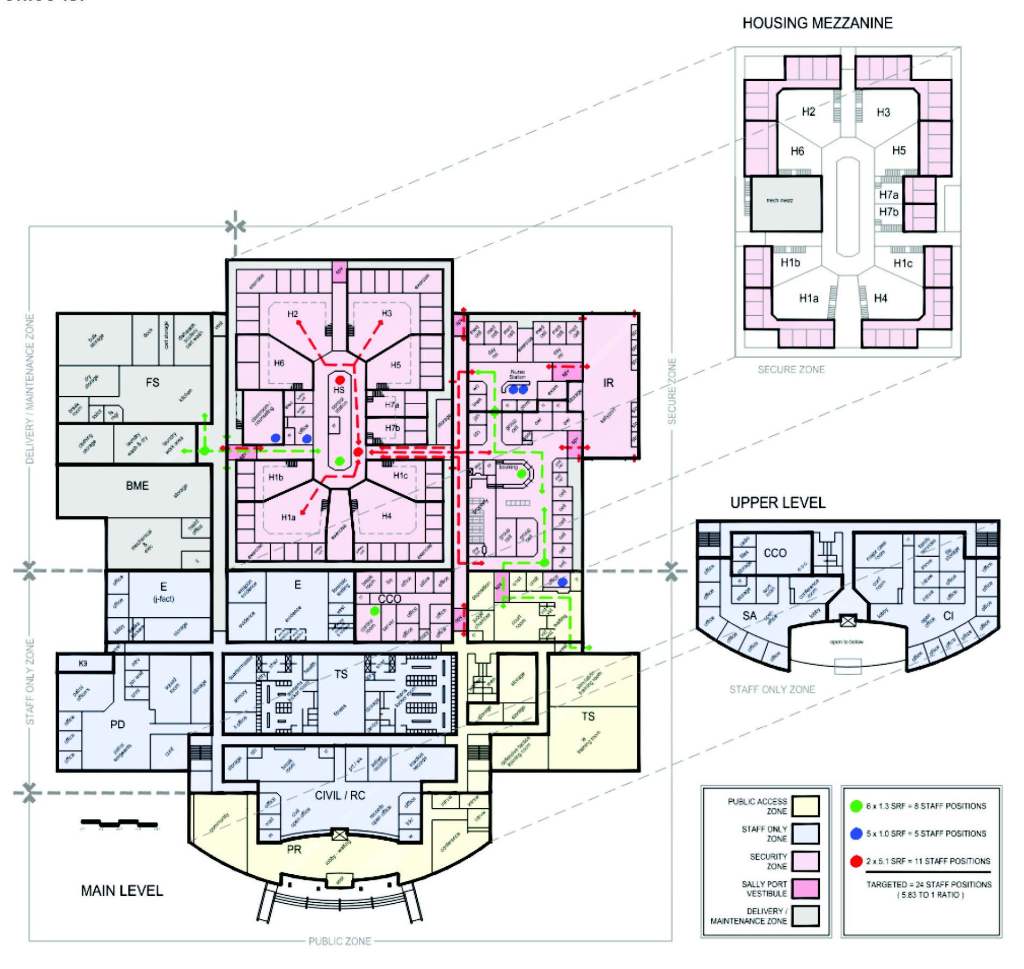
Back in May, Johnson County Sheriff Brad Kunkel and consultants from Shive-Hattery presented a preliminary jail “needs assessment” proposing an $80 million jail with the promise of a forthcoming full report in the next 10 days, giving plenty of time for digestion before a discussion a June 26 work session with the Board of Supervisors.
Instead, it arrived quietly on the week of Independence Day, with some expectation of a discussion at the Board of Supervisors’s July 10, 2024, work session (neither an agenda nor an information packet is available on the Board’s website as of this writing). You can find the report, in three volumes plus an appendix, by visiting johnsoncountyiowa.gov then by clicking on “Department Directory & Resources,” then scrolling down to “Sheriff” and clicking on “View Department,” then clicking “Jail Statistics and Studies,” then expanding “Jail Studies” and then downloading the PDFs linked at “2024 Space Needs Assessment Volume I“, “2024 Space Needs Assessment Appendix to Volume I“, “2024 Space Needs Assessment Volume II” and “2024 Space Needs Assessment Volume III“.
Some initial thoughts from my own digestion of the documents (the Prison Policy Institute’s guide to reading needs assessments is a great resource):
Only Law Enforcement was Involved in These Discussions
The assessment notes early that:
a community’s law enforcement facility (jail) is just one component of the overall criminal justice system in which the forward law enforcement facility (jail) exists. Its operations, including who enters the jail, for what purpose, and for how long, are influenced by the policies and practices of other justice system actors, including local law enforcement, prosecutors, defense attorneys and judges, as well as agencies responsible for pretrial and post-adjudication community supervision.
However most of these “actors” are absent from this report.
The list of people involved in meetings was two consultants from Shive-Hattery, one person from the Johnson County facilities management team, the Johnson County Attorney, our chief prosecutor, and 11 people from the Johnson County Sheriff’s Office.
Missing from this list are defense attorneys and public defenders who work with incarcerated people; mental health providers who might provide the important crisis services incarcerated people need; local community safety organizations who provide services that should be outside of the jail; families of incarcerated people who can speak to visitation needs; community members or others who interact with the jail; or any incarcerated or formerly incarcerated community members.
Where a project starts is important. Beginning solely with county law enforcers means only those perspectives are reflected at the starting point. Additional voices should have been included from the very start, but it will be important to ask Johnson County leaders to follow through on the consultant’s recommendation of “the formation of a Jail Task Force with public representation.”
The Bed Number was Decided Early. And then Grew.
Notes from the meetings between the architects and the Johnson County Sheriff show that at its second “user group” meeting on Oct. 23, 2023, the “group discussed that 150 beds was likely the appropriate size for this facility.” (Johnson County has not been responsible for incarcerating more than 100 people, including those electronically monitored, since before the pandemic.)
By Nov. 6, the design was 156 beds with the ability to expand to 200 beds.
By Dec. 13, the design was 156 beds with the ability to expand to 250 beds.
The report offers support for this growing need with a number of graphs including a few permutations showing Johnson County’s growing population.
One table, Table 2 Confined Incarceration Rate (Trend), shows a flat trend, presuming that we can’t further divert people from jail or take other steps to reduce our reliance on incarceration (remember: the United States incarcerates more of our population than most other countries, so it’s possible to reduce this further without falling into anarchy!).
But Table 4 shows a decreasing Confined Incarceration Bed trend that has decreased from 2015 to 2024 but is projected to begin increasing next year, without explanation.
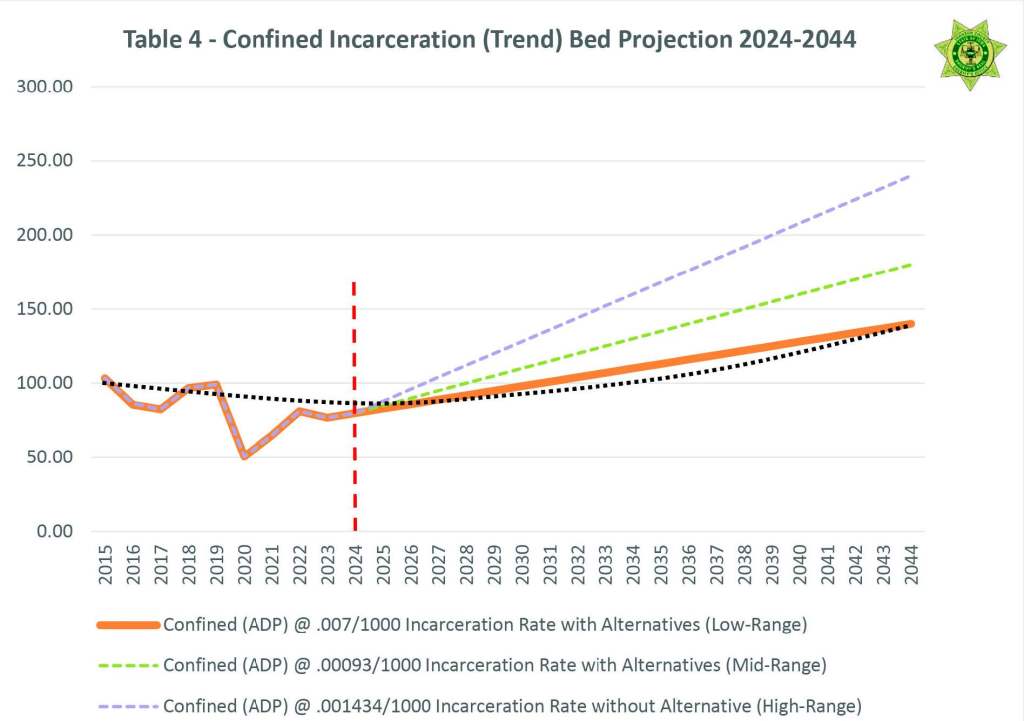
How we get to a need of 156 beds with future expansion to 250 (!) is not clear.
“Needs” is a Loosely Used Term
In this case, “needs” include, among other things:
- Interview VIP Viewing Room
- Polygraph Room
- Combined Fitness & Exercise Room (for staff)
- MRAP – Vehicle Storage
It also includes a “Defensive Tactics Training Room,” which is in addition to a regular “Training Room” and a “Simulation Training Room” as well as other multi-use group spaces. This space is larger than either planned exercise yard for community members incarcerated at the jail—notably, exercise areas are seemly explicitly excluded from cell units.
Also according to this report:
- The locker rooms would be a 70/30 male-to-female ratio, locking staff into a similar ratio
- All visitation is expected to be no-contact or by video, rather than really in-person visitation
- The site requirements are 15 to 20 acres (the current jail sits on less than 1 acre) with it being “centrally located” within the county and away from the flood plane, which suggests outside of downtown Iowa City (at least it notes the importance of the site being served by public transit)
- Despite being on the initial wish list twice, the recommendation does not appear to include a gun or shooting range
Jails are for Putting People in Cages
In Sheriff Brad Kunkel’s programming questionnaire, he wrote:
Our county and community are unique because we have a broad and deep array of services for people [who] often intersect with the justice system. We’ve spent millions over the last 20 years across various disciplines to add services and spaces to support the homeless, mentally ill, people in crisis, people with drug and alcohol addiction, people re- entering society after prison….the list goes on. And yet, our jail population continues to rise. We also see a higher concentration of inmates with behavioral, mental health, physical health, or assaultive challenges that stress our current physical limitations as well as the staff’s ability to safely and effectively manage these inmates. We need a jail that is designed to enhance staff safety when dealing with these challenges and provide the best space for humane care of the inmates.
Indeed, jails are subject to upstream forces and, as Kunkel impatiently insisted at the Board of Supervisors’s May 29 work session “we’re not going to divert our way out of violent crime.” In the near term, no, we’re not.
But this jail also includes facilities for non-violent offenders and people who have not yet been convicted of a crime.
Jails have one purpose: incarcerating people. They are not places to successfully treat mental illness or substance abuse. They are not places to house the homeless. And they are not, even with the best intentions, humane facilities for our neighbors.
 Abolition: Yes!
You must be logged in to post a comment.