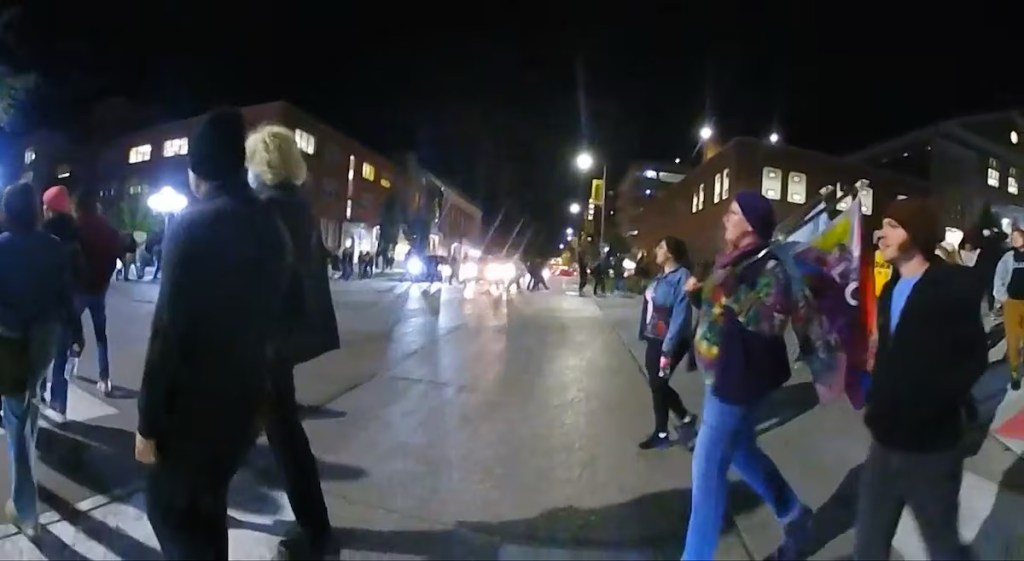
On Tuesday, Johnson County prosecutors will begin their trial against Tara McGovern, a transgender person charged for disorderly conduct obstructing streets while protesting an anti-trans speaker. Molly Hennessy-Fiske of The Washington Post has an excellent overview of the local controversy and providing national context:
While Iowa City is a politically liberal, socially progressive community, the state of Iowa has veered sharply right in recent years — and not just on LGBTQ issues. It was among 16 states to enact “Back the Blue” laws, increasing protest-related penalties following demonstrations over the killing of George Floyd in Minnesota in 2020, according to the National Conference of State Legislatures. Gov. Kim Reynolds (R) signed Iowa’s measure after her car struck a protester during a Black Lives Matter rally.
“Conservative legislatures since then have been focusing on these violations,” said Timothy Zick, a professor at William & Mary Law School whose recent book, Managed Dissent, examines laws governing street demonstrations. “The penalties are going up; the criminal penalties are getting more serious. … I would not be surprised to see more of these prosecutions going forward.”
How laws like these get enforced, or over enforced, starts with police officers and other boots-on-the-ground members of law enforcement: the way a patrol officer interprets Constitutional rights matters more in the heat of the moment than the Supreme Court.
That’s why our current system of governance is supposed to be one — famously — of checks and balances that provides oversight not just between branches of government but between its levels.
“You can’t consider these laws in isolation,” Zick said. “The more you compound laws on the protest environment, you increase criminal and civil penalties, people may decide the better course of action is not to show up at all, not to protest.”
But we’re seeing both purposeful stripping away of police oversight and a refusal of local leaders to seek meaningful accountability for police. The penalty for the more serious of the two charges McGovern is facing was increased in 2021 under the state’s Back the Blue bill.
This same bill added more qualified immunity protections for police officers, making accountability harder to achieve, and removed local policy makers’ ability to set any policy of non-enforcement. This means that while officers can still exercise their own discretion with less accountability, for example, the Iowa City City Council was forced to rescind its policy against making secondary, often pretextual, traffic stops. So some number of policing interactions that would have been out-of-bounds are now again on the table, based on individual officers’ whims.
More recently, the Iowa Senate passed a bill that would ban citizen police review boards in Iowa. These boards were already largely toothless, but are currently one of the only paths to official citizen oversight of local policing. The Fraternal Order of Police supported the bill, as did Democratic State Senator Zach Wahls, whose district includes Coralville and Iowa City, two of the five municipalities in Iowa with such boards. (There are only five such boards in the state, with three of them — Iowa City, Coralville and University Heights — in Johnson County; the others boards are in Cedar Rapids and Dubuque.)
So, how do we provide oversight of policing and how it impacts local communities if neither review boards made up of the community can provide oversight nor policymakers interested in mitigating harm can make policy?
We’re stuck relying on legal, individual discretion — a check on the right-leaning state government’s power in left-leaning Johnson County — to moderate the impacts of bad, meanspirited laws here at home.
That’s why, as Hennessy-Fiske writes, “the decision to prosecute shocked many in Iowa City, especially since it was made by a Democrat, Johnson County District Attorney Rachel Zimmermann Smith.”
One of the reasons for prosecution, given voice by former Johnson County attorney Janet Lyness, was that Iowa’s Republican attorney general could have if it wasn’t done locally.
But in our layered system, the lever for local politicians to pull is to dismiss or decline to procecute, making the state do it instead of doing the job for them.
Elections have consequences, as the saying goes, and Iowa is staring down the barrel of cycle after cycle of bad ones. But the checks and balances only work if the folks with the levers are willing to pull them.
 Abolition: Yes!