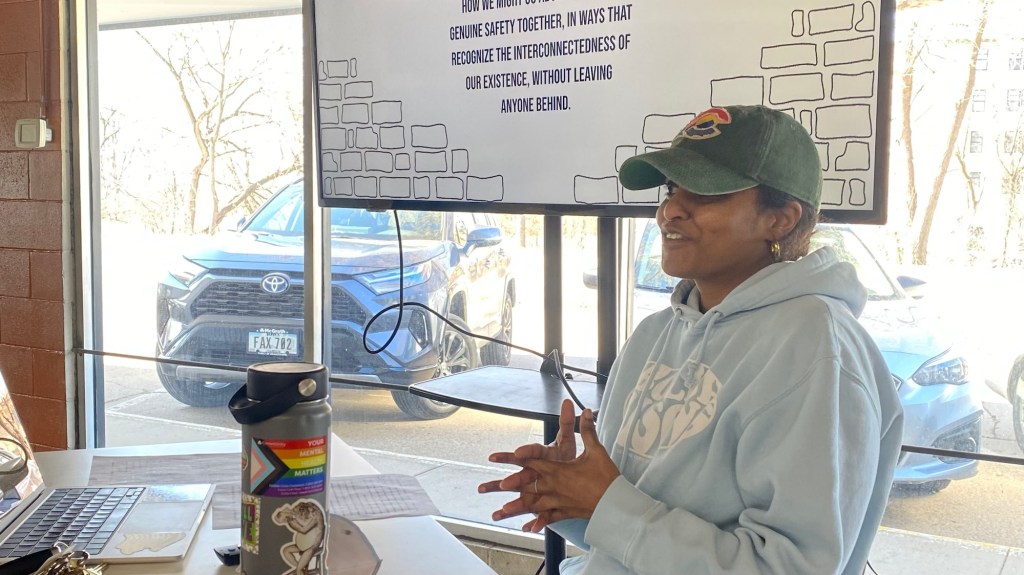
This was presented in a different form as part of the Safety Planning & Crisis Response teach-in on Feb. 17.
Safety is a fundamental human need. Not in some vague sense but in feeling safe walking-in-downtown, rear-ended on Melrose Ave and spending time in Weatherby Park.
As an abolitionist, my work requires me to actively engage in discussions and strategies that move us closer to achieving genuine and lasting safety for all. My commitment to reshaping the world is fueled by my dream of creating an environment where everyone is safe and thrives.
My vision of a world free of police and punishment is rooted in the recognition that, for many including myself, punitive law enforcement fails to address violence and, in some cases, contributes to it.
To advance safety at a local level, I advocate for divesting financially, ideologically, and emotionally from the violent aspects of policing, and challenge fears perpetuated by propaganda and societal conditioning that limit our view of safety options to the police and the carceral state.
For many individuals and communities affected by violence, our perception of safety is often influenced by the lack of support we receive – be it from the police or others – when we experience harm. There’s a lingering hope that, in future instances, police will respond effectively. In many communities, the police stand as the primary government resource available to address a wide range of needs, conflicts, and harms. The simple idea of removing the police from the equation raises fear and apprehension about facing increased vulnerability to violence without alternative structures or institutions to ensure safety and meet community needs.
Abolition necessitates a deconstruction of the very idea of safety. Although safety is a fundamental and universally recognized human need, it doesn’t conform to a singular definition for everyone. Our individual sense of safety is influenced by a multitude of factors. For instance, recent events such as receiving a paycheck might alleviate concerns about rent payments. Additionally, an individual’s activities for the day—whether they ventured outdoors or remained inside—could shape their perception of safety.
Moreover, exposure to media narratives, including copaganda and reports of violent crimes, could impact our feelings of security.
Considerations like having a support network in times of crisis instead of facing challenges alone also contribute to nuanced understandings of safety.
None of us can achieve perfect and constant safety in every circumstance. We all harbor vulnerabilities — be it to natural elements, disasters like earthquakes or hurricanes, harm from fellow inhabitants of the planet, or the uncertainties of human existence in an expansive universe. These perceptions of safety are contextual and relational, rather than absolute or categorical. The more practical inquiry revolves around how to enhance safety for a broader populace, recognizing that safety is a contested concept with fluid meanings. While our levels of risk differ, our exposure to natural disasters, violence, trauma, and opportunities for recovery is intricately woven into the fabric of racial capitalism.
Policing contributes to a sense of insecurity by consistently reinforcing the notion that safety is an unattainable state, whether or not police are present. Police and their advocates then exploit this insecurity to carry out extensive violence, all in the name of pursuing an impossible and elusive “safety.” Instead of embodying safety, their presence signifies and announces its absence. The state plays a role in perpetuating this dynamic by amplifying our fear of one another and undermining our ability to care for each other. This is evident locally as they critique de-escalation training, resist the establishment of non-police crisis response teams, and actively avoid grassroots violence prevention and interruption initiatives. Abolitionists perceive safety as a collection of resources, relationships, skills, and tools that can be cultivated, shared, and used to prevent, intervene, and heal from harm. Our aim is to expand the array of tools that enhance safety for a broad spectrum of people, eliminate ineffective tools such as policing and punishment, and dismantle the fear that fuels safety politics. Creating and reinforcing the relationships essential for collective safety requires overcoming the fear and alienation instigated by the state.
 Abolition: Yes!